
Running a business in Karachi in 2026 is expensive. Electricity bills are up. FBR is tightening compliance. Staff costs keep rising. And the upcoming 2026-27 budget season is adding more uncertainty for small and medium businesses across Pakistan.
The businesses surviving right now are not the ones with the biggest budgets. They are the ones spending smarter, cutting what wastes money while protecting what generates it.
This is a practical guide to 5 specific cost-cutting moves Karachi businesses are making in 2026 that actually work, with real numbers behind each one.
Why Cutting Costs in Pakistan Right Now Is Harder Than It Looks
The instinct most business owners have when costs rise is to cut people or cut marketing. Both are usually wrong.
Cutting staff reduces your capacity to serve customers, which reduces revenue faster than it reduces costs. Cutting marketing reduces the flow of new leads at exactly the moment you need more conversions from fewer rupees spent.
The smarter approach is to identify where money is being wasted on processes that can be automated, replaced, or eliminated entirely, without touching the parts of your business that generate revenue.
Here is where Karachi businesses are finding the biggest wins in 2026.
1. Replacing Manual WhatsApp Management With Automation
This is the single highest-impact cost reduction available to most Pakistani SMBs right now, and it is the one most business owners have not done yet.
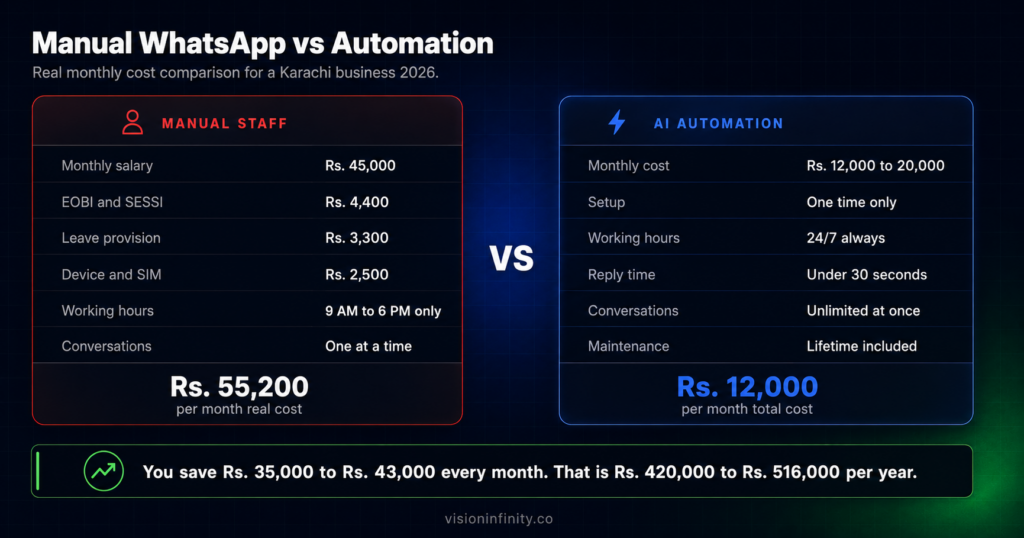
The typical Karachi business managing WhatsApp manually either dedicates a staff member to it full-time or splits the responsibility across multiple people. Based on current salary data, a dedicated WhatsApp support person costs between Rs. 35,000 and Rs. 55,000 per month in salary alone, rising to Rs. 50,000 to Rs. 70,000 when you include employer contributions, leave provision, and device costs.
That same function, replying to inquiries, qualifying leads, booking appointments, answering FAQs, can be handled by a WhatsApp AI system for Rs. 12,000 to Rs. 20,000 per month. The AI replies in under 30 seconds. It works 24 hours a day. It handles multiple conversations simultaneously. It never takes a sick day or resigns.
The saving: Rs. 30,000 to Rs. 50,000 per month, every month. Over a year that is Rs. 360,000 to Rs. 600,000 returned directly to your bottom line.
What you do not lose: Response speed actually improves. Customer satisfaction improves because replies are instant instead of delayed. Lead capture improves because no inquiry goes unanswered after 7 PM.
For businesses that cannot justify even a monthly subscription right now, Vision Infinity is currently offering a lifetime deal, one payment of $200 (approximately Rs. 55,600) for a fully custom-built WhatsApp AI system with lifetime maintenance and zero monthly fees. Details at visioninfinity.co.
2. Stopping Ad Spend Waste by Fixing the WhatsApp Funnel
Most Karachi businesses running Meta Ads are wasting between 30% and 50% of their ad budget without knowing it.
Here is how it happens. You run a Facebook or Instagram ad. A potential customer clicks it and lands on your WhatsApp. They message you. Nobody replies for 4 hours, or until the next morning. The lead goes cold. You never see it again. But you paid for that click.
Pakistan’s social media ad spend reached USD 75 million in 2026, with 10 to 12% annual growth. That is a lot of money flowing into ads, with a large portion of it leaking out through slow WhatsApp follow-up.
The fix is not to spend less on ads. It is to stop wasting the spend you already have by ensuring every lead gets an instant reply. When an automated system responds to every ad-generated lead within 30 seconds, the same ad budget converts significantly better.
The saving: If you spend Rs. 50,000 per month on Meta Ads and currently convert at 8% due to slow replies, improving conversion to 14% through instant automated follow-up generates the equivalent of Rs. 30,000 in additional revenue from the same spend, without increasing your ad budget by a single rupee.
3. Reducing Utility Costs With Smarter Operating Hours
One of the biggest concerns for small businesses in Pakistan is the rising cost of utilities. Electricity tariffs and gas prices have increased operating expenses, particularly for businesses that rely on machinery, refrigeration, or extended working hours.
For service businesses and offices, one of the most overlooked utility costs is the electricity consumed by maintaining extended operating hours specifically to handle customer inquiries. Salons staying open late. Offices keeping lights and AC running because a staff member is handling WhatsApp until 9 PM. Restaurants keeping front-of-house staff on duty to manage order inquiries that could be handled automatically.
When customer communication is automated, the hours your physical premises need to remain staffed for that purpose shrink considerably. This translates directly into reduced utility consumption and reduced overtime pay.
Practical move: Identify which staff hours exist primarily to handle incoming messages and inquiries. Calculate the electricity and salary cost of those hours. Compare it to the cost of automation covering those exact hours instead.
4. Cutting the Cost of Missed Leads
This one is counterintuitive as a cost because it looks like a revenue problem. But missed leads have a real cost that most business owners never calculate.
Here is the formula. Take your average monthly lead volume. Estimate what percentage you miss, after hours, during busy periods, when staff are occupied. Multiply those missed leads by your average conversion rate and your average deal or transaction value.
For a real estate agency in Karachi receiving 60 WhatsApp inquiries per month through Meta Ads, missing 20 of them after hours, with a 15% conversion rate and an average commission of Rs. 80,000, that is 3 missed conversions per month worth Rs. 240,000 in lost revenue. Every single month.
That is not a revenue problem. That is a cost, the cost of not having a system that captures every lead regardless of when it arrives.
Rental yields for apartments in Karachi currently average around 6.21%, making it one of the more profitable cities in Pakistan for real estate returns. In a growing market with genuine buyer demand, the cost of missing leads is higher than ever.
The saving: Capturing leads that currently go unanswered is not an additional expense. It is recovering money that is already being lost.
5. Consolidating Tools and Subscriptions
Small businesses are adapting by cutting costs, switching suppliers, or offering new products and services. Others are turning to digital platforms to reach customers and reduce overheads.
Most businesses in Karachi are paying for more software subscriptions than they realise. A CRM they barely use. A scheduling tool for appointments. A separate broadcast tool for WhatsApp messages. An Excel or Google Sheets setup that someone manually updates.
A properly built WhatsApp automation system replaces several of these simultaneously. It qualifies and logs leads automatically into Google Sheets, eliminating the need for a separate CRM at the early stages. It handles appointment booking, eliminating a separate scheduling tool. It manages follow-ups automatically, eliminating manual broadcast tools.
Practical audit to run today: List every software subscription your business pays for monthly. For each one, write down the specific job it does. Then identify which of those jobs a unified WhatsApp automation system already covers. Most Karachi SMBs find they can eliminate 2 to 4 subscriptions worth Rs. 5,000 to Rs. 15,000 per month combined.
The Budget 2026-27 Context: Why This Matters More Right Now
The Lahore Chamber of Commerce and Industry presented budget proposals to Finance Minister Muhammad Aurangzeb, with recommendations centred on industrial revival, export growth, tax reforms, and lowering the cost of doing business.
The business community across Pakistan is actively pushing for cost relief in the upcoming budget. That conversation reflects a real pressure that every small business owner in Karachi is feeling right now.
The budget may or may not deliver relief. What you can control in the meantime is your own cost structure, and the five areas above are all within your control to act on today, without waiting for a government policy change.
Pakistan’s private sector confidence deteriorated sharply in the first quarter of 2026. Businesses that cut costs intelligently now, without reducing capacity or quality, will be in a significantly stronger position when confidence recovers and growth accelerates.
Where to Start
If you are a Karachi business owner looking to reduce costs without reducing growth, the highest-impact starting point is almost always WhatsApp, because it touches your customer acquisition cost, your staff cost, your utility cost, and your lead capture rate simultaneously.
Vision Infinity builds custom WhatsApp automation systems for Pakistani businesses across real estate, salons, clinics, restaurants, and e-commerce. Every system is trained specifically on your business, connected to your existing WhatsApp number, live in 7 days, and currently available as a lifetime deal for a one-time payment of $200 with no monthly fees ever.
Book a free 30-minute consultation and we will calculate the exact monthly saving your business would see from automation before you commit to anything.
Or message us directly: +92 312 877 9368
Vision Infinity is a Karachi-based WhatsApp automation company serving real estate agencies, salons, clinics, restaurants, e-commerce stores, and service businesses across Pakistan.